Baby Hippo Care: Kids Game
Reviews
Baby Hippo Care: Kids Game keeps its scope narrow and its tone reassuring. The hippo's mood indicators give children a readable problem to solve, and every action produces an immediate, cheerful response. That feedback loop is the strongest part of the design: it turns basic care tasks into a lesson about noticing and responding to needs. The lack of complex rules, timers, or failure states makes it suitable for toddlers and preschoolers, though older children may find the routine repetitive. Parents looking for a calm, family-friendly introduction to pet care will find it fits that purpose.
Description
What Players Do
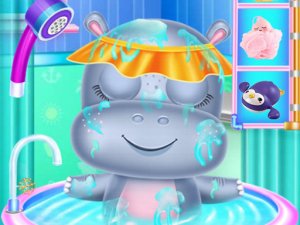
Baby Hippo Care: Kids Game assigns one clear job: keep a young hippo content while it stays alone at home. The animal shows what it needs through mood indicators and expressive reactions. When it is hungry, players drag food to its mouth. When it seems bored, they pick a toy and play together. When it needs cleaning, a click with the cleaning tool tidies the space. Each correct action produces a cheerful response, so children can see the link between their choice and the hippo's mood.
Controls and Accessibility
Interaction relies on a mouse or a touch screen, with no complex menus or timed sequences. The game supplies clear hints that point to the next suitable action, which reduces guesswork for small hands and limited motor skills. Because the hippo's signals are visible rather than hidden, children can act at their own pace. The design avoids frustration by keeping every required step simple and by confirming success immediately after it happens.
Learning Through Care Routines
The core loop is a short care routine: notice a signal, choose the matching tool or item, and watch the hippo respond. That pattern introduces cause and effect in a low-pressure setting. Trying different foods or toys changes how the hippo reacts, which encourages exploration without penalty. Over repeated sessions, the routine reinforces consistency and attention to another creature's needs, which is the game's stated aim of practicing empathy and responsibility.
Mini-Games and Variety
Short mini-games break up the care tasks and add variety for young players. They sit alongside feeding, bathing, and playing rather than replacing them, so the main focus stays on looking after the hippo. The overall content is family-friendly, and the game is built for toddlers and preschoolers to play independently.




Editorial Notes